
Last updated June 30, 2026
The Complete Guide to Gate Repair in Palmdale
The Antelope Valley hits 110°F in summer and drops below freezing in January — that 90-degree temperature swing does more cumulative damage to gate hardware than a decade of normal use anywhere else in California, yet most gate repair guides are written as if climate doesn’t exist. Add in Palmdale’s caliche-hardened soil that shifts post footings like slow-motion earthquakes, and the high desert dust that grinds bearings down to powder, and you’ve got a repair environment unlike anything on the coast. This guide explains exactly what’s actually breaking your gate, why it keeps coming back, and what a lasting fix looks like here in Palmdale.
Quick Answer
Gate repair in Palmdale covers mechanical, electrical, structural, access control, and sensor failures — and the vast majority of those failures trace back to three local forces: extreme heat expansion, caliche soil movement, and undersized operators. Identifying the correct root cause on the first visit is what separates a permanent repair from a temporary patch. Most repairs in Palmdale can be completed same-day once the true cause is diagnosed.
Table of Contents
- How Palmdale’s Climate Destroys Gate Hardware
- The Caliche Problem: Why Your Posts Are Shifting
- Operator Sizing: Why Your Motor Is Losing the Fight
- The Five Most Common Gate Repair Categories
- Repair or Replace? Honest Thresholds Most Contractors Skip
- Gate Repair Costs in Palmdale
- Common Mistakes to Avoid
- When to Call a Professional
- Frequently Asked Questions
- The Bottom Line
How Palmdale’s Climate Destroys Gate Hardware Faster Than You’d Expect
Coastal California gate guides talk about salt air and moisture. Out here in Palmdale, the threats are completely different: extreme heat, rapid temperature cycling, UV radiation, and relentless fine-particle dust. Each one attacks a specific part of your gate system, and together they compress what might be a 15-year hardware lifespan in a moderate climate down to 7 or 8 years — sometimes less.
Heat expansion is the most underappreciated force on any metal gate in Palmdale. A 20-foot steel sliding gate can expand roughly 3/16 of an inch on a 110°F afternoon compared to a cool morning. That sounds small until you realize the gate is trying to expand inside a frame that’s bolted to a post, against rollers that already have dust packed into their bearings. The expansion creates friction. The friction creates motor strain. The motor strain shortens controller board life. Every summer, the cycle repeats and the damage compounds.
UV degradation hits rubber components — bottom seals, wiring insulation, and photoeye sensor housings — especially hard at Palmdale’s elevation. We regularly see sensor wiring that looks intact from a distance but is actually brittle and cracked at the housing junction, causing intermittent open/close failures that look electrical but are really just sun damage.
High desert dust is the slow killer. The fine particulate that blows through Palmdale and the surrounding Antelope Valley works into hinge bushings, roller bearings, and motor drive gears. Unlike coastal moisture, dust doesn’t announce itself with rust — it quietly increases friction until the motor can’t overcome the load, and the gate either slows to a crawl or throws a motor overload fault.
The fix isn’t just replacing the worn part. It’s using heat-rated grease on all moving components, UV-resistant wiring at exposed junctions, and sealed bearings where open ones were originally spec’d. That’s the difference between a repair that lasts and one that brings you back to the same failure in 18 months.
The Caliche Problem: Why Your Gate Posts Are Shifting
If you’ve lived in Palmdale for any length of time, you’ve probably heard someone mention caliche — the calcium carbonate hardpan layer that sits anywhere from a few inches to a few feet below the surface across most of the Antelope Valley. What most homeowners don’t know is what caliche does to gate post footings over time, and why the resulting misalignment keeps being mis-diagnosed as a motor problem.
Here’s the mechanism: caliche is hard when dry, but when it does absorb water — from irrigation overspray, a slow pipe leak, or a heavy winter rain — it can swell, shift, and then re-harden in a new position. A concrete footing poured into caliche-heavy soil doesn’t have the same lateral stability as a footing poured in deep, uniform soil. Over three to five years, a post can tilt a quarter-inch or more. That’s enough to put the gate frame out of square with the strike post, throw off the ground track alignment on a slide gate, or cause a swing gate to drag at the bottom on its latch-side arc.
The misalignment symptoms that result are:
- Gate scrapes or sparks along the bottom track
- Swing gate that doesn’t fully latch without a manual push
- Uneven gap between gate and frame — wide at top, tight at bottom (or vice versa)
- Motor working harder than usual, triggering thermal shutdowns
- Chain or belt showing unusual wear on one side
A technician who doesn’t check post plumb before diagnosing these symptoms will replace rollers, adjust the limit switches, or swap the motor — none of which solves anything if the post moved. In neighborhoods like Anaverde and Shadow Hills, where irrigation systems run regularly near gate posts, we see this pattern more often than anywhere else in Palmdale. The correct repair addresses the footing first, then adjusts the hardware to match the corrected geometry.
Operator Sizing: Why Your Motor Is Losing the Fight
Gate operators — the motor and controller unit that moves your gate — are rated by duty cycle and gate weight. Most residential operators sold through big box stores and general contractors are sized for the gate as it was originally installed: clean, properly aligned, moving freely. They are not sized for the gate after five Palmdale summers of heat expansion, dust accumulation, and a post that’s drifted 3/8 of an inch out of plumb.
As a gate’s mechanical resistance increases over time, an operator that was correctly sized at installation starts running at a higher percentage of its rated torque on every cycle. Running consistently near peak torque shortens capacitor life, accelerates motor brush wear, and eventually kills the control board. The symptom looks like an electrical failure — and replacing the board fixes it temporarily — but the real problem is that the operator is undersized for the actual current load.
Here’s a simplified way to think about the math: a residential sliding gate that weighed 400 lbs when installed and ran on a mid-duty operator at 60% of peak torque might now require 85% of peak torque because of accumulated friction and misalignment. That 25-percentage-point increase in load is the difference between a motor that runs cool and one that thermally shuts down on a July afternoon when you need it most.
The right solution in this scenario isn’t just another board replacement. It’s correcting the mechanical resistance first — lubricate, realign, replace worn rollers — and then assessing whether the operator’s duty cycle rating still matches the gate’s actual demand. Brands like Viking and Linear offer commercial-grade operators with higher duty cycles that are worth the upgrade cost in high-use or high-temperature environments like Palmdale. We carry both and can assess whether a heavier-duty unit makes sense for your specific gate before you spend money on a like-for-like swap that’ll fail again in two years.
The Five Most Common Gate Repair Categories in Palmdale
1. Mechanical Failures
This category covers the physical moving parts: rollers, hinges, tracks, chains, belts, and wheels. In Palmdale, mechanical failures are the most common category we see — dust-packed rollers and seized hinge pins account for a significant portion of “my gate won’t open” calls. The repair is often straightforward once the root cause (heat, dust, or post shift) is addressed alongside the worn part.
2. Electrical Failures
Control boards, transformers, wiring harnesses, and motor capacitors all fall here. Palmdale’s temperature extremes are particularly hard on capacitors, which lose capacitance faster at high temperatures. UV damage to exterior wiring insulation is also common. An electrical diagnosis should always include a physical inspection of exposed wiring runs, not just a board swap.
3. Structural Failures
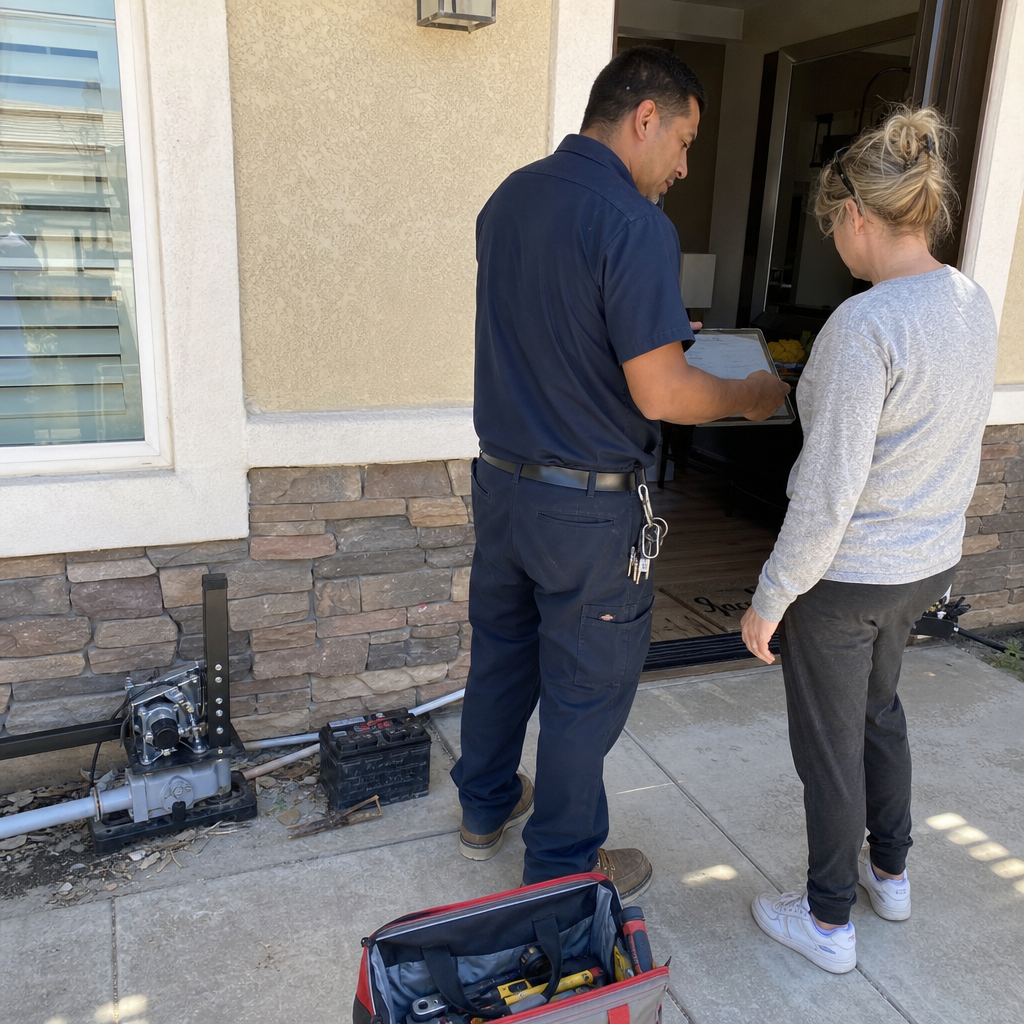
Bent frames, cracked welds, broken pickets, and post damage. A gate that’s been struck by a vehicle or has suffered years of caliche-related stress may have structural compromise that no amount of tuning or motor replacement will fix. This is where in-house welding capability matters — we weld and fabricate on-site in Palmdale, so structural repairs don’t wait on a metal shop’s schedule.
4. Access Control Failures
Keypads, card readers, intercoms, loop detectors, and remote receivers. These systems are often the last thing homeowners think about until they stop working. In Palmdale’s HOA communities — Anaverde Hill, The Resort at Shadow Hills — access control failures affect everyone in the community simultaneously, making fast diagnosis essential.
5. Safety Sensor Failures
Photoeye sensors (the infrared beam that stops a gate from closing on a person or vehicle) are a safety-critical component. A gate that closes on an obstruction without reversing is a liability and a hazard. UV damage to sensor housings and misalignment from post movement are the two most common causes in Palmdale. Important: never bypass or disable a safety sensor to get a gate running — a gate moving without functioning obstruction detection can cause serious injury. Call a trained technician to restore the sensor correctly.
Repair or Replace? The Honest Thresholds Most Contractors Skip
Most gate contractors — especially generalists — will tell you what you want to hear. “We can fix it” means a job today. “You need a new gate” means a bigger job. Neither answer is automatically honest. Here’s the framework we use after 14 years of gates, only gates, to make that call objectively.
Repair makes sense when:
- The gate frame is structurally sound — plumb, square, no significant weld cracks
- The post footings are stable or can be releveled without full excavation
- The operator failure is isolated to a single component (board, capacitor, motor) and the unit is less than 8 years old
- Mechanical wear is moderate and the repair cost is under 50% of replacement cost
- The gate style and material still meet your security and aesthetic needs
Replacement is the smarter investment when:
- The frame has multiple cracked welds or is significantly out of square beyond what welding can correct economically
- The post footings have shifted so severely that releveling requires full excavation and re-pour
- The operator is more than 10 years old and has failed twice in 24 months — you’re funding a slow death
- Cumulative repair cost is approaching or exceeding 60–70% of a new gate’s installed price
- The gate no longer meets current security needs (inadequate height, outdated access control infrastructure)
One honest note: if a contractor quotes you a repair without checking post plumb and frame squareness first, they’re guessing. Any quote for work on a gate in Palmdale should start with a physical assessment of the structure, not just the motor.
Gate Repair Costs in Palmdale
Gate repair pricing in Palmdale varies by repair category, gate type, and whether structural work is involved. The ranges below reflect current Palmdale-area market pricing for professional gate repair — not DIY parts costs.
| Repair Type | Typical Palmdale Price Range |
|---|---|
| Roller / track replacement (slide gate) | $150 – $320 |
| Hinge repair or replacement (swing gate) | $120 – $280 |
| Motor capacitor replacement | $95 – $175 |
| Control board replacement | $220 – $480 |
| Photoeye sensor realignment or replacement | $85 – $200 |
| Gate operator replacement (residential) | $550 – $1,100 installed |
| Structural weld repair (frame or hinge plate) | $175 – $450 |
| Post releveling (minor, no excavation) | $200 – $400 |
| Access control keypad replacement | $180 – $380 installed |
These ranges assume a single primary repair. Many service calls involve two or three related repairs — for example, a seized roller and a worn chain — so it’s normal for a complete restoration service to land above the single-line figures. We provide a written estimate before any work begins, so there are no surprises on the final invoice. Call (661) 582-0783 for a free on-site estimate.
Common Mistakes to Avoid
- Replacing the motor without fixing the mechanical resistance first. A new operator installed on a gate with packed bearings, misaligned track, or a shifted post will fail in the same way as the old one — usually within 12 to 18 months. Always correct friction before sizing or swapping a motor.
- Using the wrong lubricant on gate components in Palmdale’s heat. Standard WD-40 or light-grade aerosol lubricants burn off quickly at Antelope Valley temperatures and can actually attract the fine dust that accelerates bearing wear. Use a high-temperature, dust-resistant grease formulated for outdoor mechanical components.
- Ignoring a gate that’s “working but slow.” A gate that takes noticeably longer to open than it used to is telling you it’s running near peak motor load. Addressing the friction or misalignment now costs far less than a burned-out control board and motor replacement later.
- Bypassing or covering a photoeye sensor to stop nuisance reversals. When a sensor reverses the gate for no apparent reason, the correct response is to diagnose the sensor — not tape over it or disconnect it. A gate operating without functional obstruction detection can cause serious injury and creates real liability for the property owner.
- Hiring a general handyman or fencing contractor to diagnose an operator or access control failure. Gate operators and access control systems are specialized electronics. A fencing contractor is skilled at building structure — diagnosing a Ghost Controls or BFT controller fault requires brand-specific knowledge that most generalists simply don’t have.
- Pouring a new footing without checking for caliche depth. In Palmdale, a post footing that doesn’t account for the caliche layer — either by drilling through it or anchoring into it properly — will shift again within a few years. Confirm soil conditions before any new footing work.
- Deferring a cracked weld because the gate still moves. A gate frame with a cracked weld at the corner joint or hinge plate is load-bearing under stress every time the gate cycles. What starts as a hairline crack in spring becomes a failed joint by August when the metal is expanding at peak heat. Weld repairs are far cheaper than fabricating a new gate section.
When to Call a Professional
Some gate issues genuinely reward a careful DIY approach — cleaning dust from a keypad, adjusting a simple limit switch, or lubricating a hinge. But several scenarios in Palmdale call for a trained technician from the first moment:
- The gate moved on its own, or won’t stop moving — this is a control board or loop detector fault that can cause injury if not diagnosed correctly.
- You can see a cracked weld, a bent main frame member, or a post that is visibly leaning — structural compromise needs welding or releveling, not adjustment.
- The gate struck a vehicle or person and the safety sensors didn’t reverse it — the sensor system must be restored before the gate is used again.
- The operator throws error codes you can’t resolve through the manual — brand-specific fault codes often require factory-trained diagnosis.
- The gate is in an HOA or commercial property and failure is affecting multiple residents or tenants — downtime has a real cost and guesswork is expensive.
First Choice Gate Repair Palmdale offers free estimates in Palmdale — Charles Rodriguez will assess the gate in person and give you a straight answer on what it needs before any work begins. Call (661) 582-0783 to schedule.
Frequently Asked Questions
Most residential gate repairs in Palmdale range from $95 for a simple sensor adjustment to $480 or more for a control board replacement, with a full operator swap running $550–$1,100 installed. The wide range reflects the difference between a single-component fix and a multi-part restoration. The most reliable way to get an accurate number is an on-site estimate — call (661) 582-0783 and we’ll come out for free.
This is one of the most Palmdale-specific symptoms we diagnose, and it almost always traces back to heat expansion. As the gate frame warms through the day, metal expands and mechanical friction increases — a motor that handles the load at 70°F in the morning may hit its thermal shutoff at 105°F in the afternoon. The fix involves reducing friction (lubrication, roller replacement, alignment correction) rather than replacing the motor, which won’t solve the underlying cause.
Yes, most repairs can be completed same-day. Because we stock a wide range of parts on the truck — including components for Viking, Linear, Ghost Controls, BFT, and several other major brands — we don’t have to order and wait in most cases. Structural repairs requiring fabrication of custom pieces may take an additional day, but standard mechanical and electrical repairs are almost always handled on the first visit.
A leaning post in Palmdale is almost always a caliche soil movement issue, and yes, it’s worth addressing promptly. A post that’s out of plumb puts asymmetric stress on your gate frame, accelerates wear on rollers and hinges, and forces your motor to work harder on every cycle. Caught early, releveling is a manageable repair. Left alone for a few years, it can compromise the footing enough to require full excavation and re-pour, which is significantly more involved.
Repair wins financially when the gate frame is structurally sound and the operator is under about 8–10 years old. Replacement becomes the better investment when cumulative repair costs are approaching 60–70% of a new installed gate, the frame has significant structural damage, or the operator has failed repeatedly in a short window. We’ll give you an honest assessment on that threshold — we’ve turned down gate replacements that only needed a motor and structural weld, and we’ve recommended replacement when a repair would’ve been throwing good money after bad.
Yes, and HOA gate work is a meaningful part of what we do in Palmdale. Communities in areas like Anaverde and the West Palmdale corridors often run Gate Repair in Vincent-adjacent access systems on DoorKing or similar commercial-grade controllers. We’re experienced on those systems, understand the urgency when an entire community is locked out or in, and can coordinate with HOA property managers directly. Call (661) 582-0783 to discuss your community’s specific setup.
The Bottom Line
Most gate failures in Palmdale aren’t random — they’re predictable consequences of extreme heat, caliche soil movement, and operators that were never sized for the real long-term load. Understanding those three root causes changes how you respond to a gate problem: instead of patching the symptom, you fix the cause. A repair that addresses why the roller seized, why the motor overloaded, or why the post shifted will last years longer than one that just swaps the broken part. Over 600 neighbors in Palmdale have trusted Charles Rodriguez and First Choice Gate Repair to make that call correctly the first time — and after 14 years of gates, only gates, that pattern recognition is what we bring to every job.
For expert gate repair anywhere in Palmdale — or if you need Gate Installation in Vincent or Gate Motor & Opener in Vincent service — call (661) 582-0783 for a free estimate. Charles handles every assessment personally, gives you a straight answer on what the gate actually needs, and has the parts and welding capability on-site to handle it the same day in most cases.
Written by Charles Rodriguez, Owner & Lead Technician at First Choice Gate Repair Palmdale, serving Palmdale since 2012.