
Last updated June 30, 2026
How to Hire a Gate Repair Contractor in Palmdale: A Step-by-Step Guide
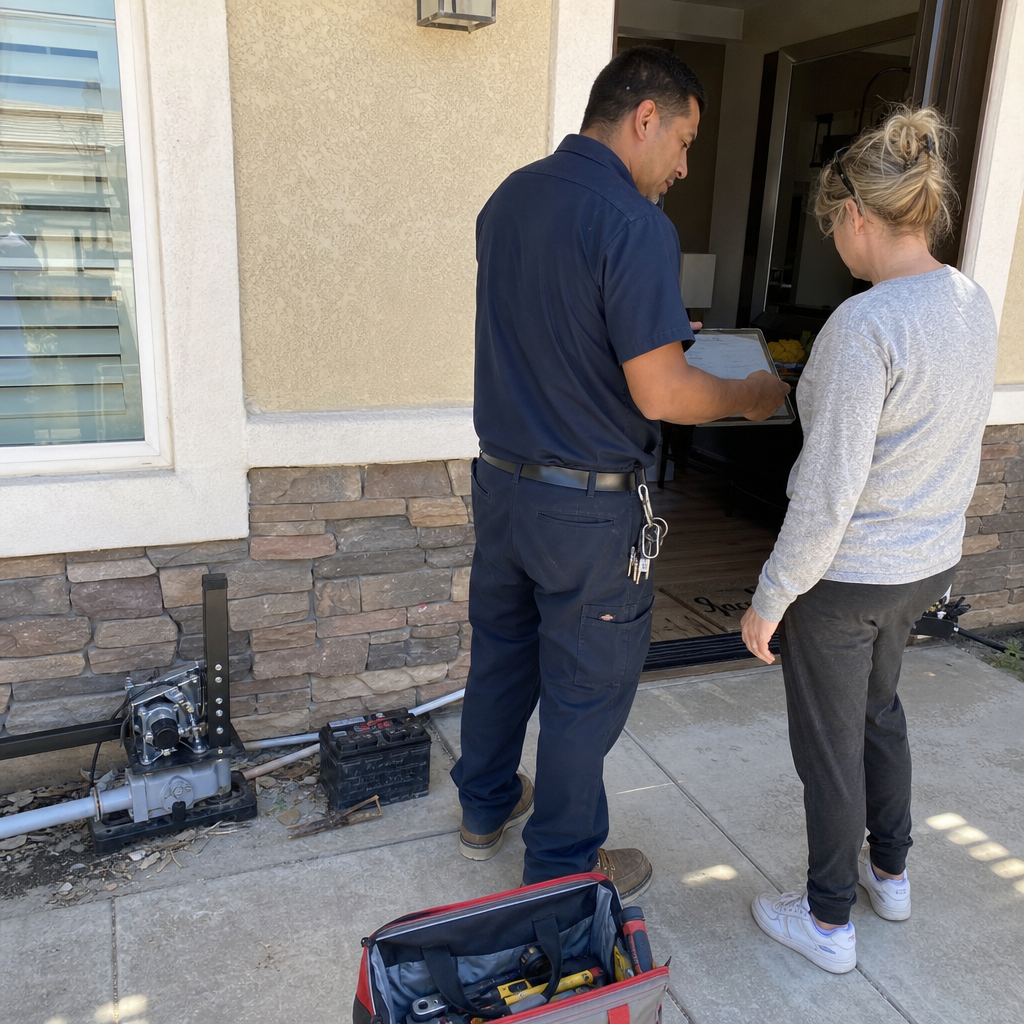
There is no California contractor’s license category called “gate repair” — which means the person quoting you $150 to fix your operator and the 14-year specialist quoting you $280 look identical on paper. Gate work sits in an awkward gap between licensed electricians, fence contractors, and general handymen, and most Palmdale homeowners don’t discover the difference until they’re scheduling a second service call to fix the first technician’s mistakes. This guide gives you the exact vetting framework to separate a real gate technician from someone who watched a YouTube video — before you hand over a check.
Quick Answer
To hire a gate repair contractor in Palmdale, verify they hold a California C-10 (Electrical) or C-13 (Fencing) contractor’s license, ask them five specific technical questions about your gate system before they quote, and confirm they can name the exact replacement parts they’ll use. A qualified specialist will measure your gate’s weight, ask about daily cycle count, and provide an itemized written quote — not a flat number pulled from thin air.
Table of Contents
- What California Contractor Licenses Actually Apply to Gate Work
- Five Technical Questions to Ask Before You Hire Anyone
- Red Flags Specific to Gate Repair Contractors
- The Handyman Trap: Why Cheaper Upfront Costs More Later
- How to Read a Gate Repair Quote
- Palmdale-Specific Factors That Affect Gate Repair
- Common Mistakes to Avoid
- When to Call a Professional
- Frequently Asked Questions
- The Bottom Line
What California Contractor Licenses Actually Apply to Gate Work
Most homeowners assume that anyone fixing a gate must hold some kind of “gate license.” That category doesn’t exist in California’s contractor classification system. What does exist are two license types that legitimately cover gate work, and knowing which one applies to your situation tells you a lot about who you should be hiring.
C-10 Electrical Contractor: If your gate has a motor, operator, access control keypad, loop detector, or any wired component — and virtually every automated gate does — the electrical portion of that work falls under the C-10 classification. A contractor modifying wiring, installing a new operator, or programming an access control board should ideally hold or employ someone with a C-10 license. In Palmdale, where many residential and HOA communities rely on DoorKing and Viking access systems, this matters more than most homeowners realize.
C-13 Fencing Contractor: Structural gate work — welding a broken frame, rehanging a sagging swing gate, repairing a post — falls under the C-13 fencing classification. If a contractor is doing purely mechanical and structural work without touching wiring, the C-13 covers them.
What this means practically:
- Ask every contractor: “Which California contractor’s license classification covers the work you’ll do on my gate?”
- A legitimate answer names C-10 or C-13 (or both) and includes a license number you can verify at CSLB.ca.gov in under two minutes.
- A vague answer — “I’m registered,” “I have a business license,” or silence — is a meaningful red flag.
- General handymen operating under an unlicensed or exempt status can legally do minor repairs under a certain dollar threshold, but gate motor replacement and access control work typically exceed that threshold.
The license question isn’t about gatekeeping — it’s a fast filter that separates contractors who have formally demonstrated competence from those who haven’t.
Five Technical Questions to Ask Before You Hire Anyone
These aren’t trick questions. They’re the same questions an experienced gate technician would answer automatically when sizing up a job. If a contractor stumbles on more than one of them, you have your answer about their experience level.
-
“Can you tell me the approximate weight of my gate before you quote?”
Gate operator selection — and whether your current operator is undersized for your gate — depends entirely on gate weight. A technician who doesn’t ask about or measure gate weight before quoting a motor replacement is guessing. Ghost Controls operators, for example, are rated for specific weight and length combinations, and installing the wrong unit will cause premature motor failure within months. -
“What’s the daily cycle rating on the operator you’re recommending?”
A residential Viking or LiftMaster operator might be rated for 15–20 cycles per day. An HOA gate running 80+ cycles daily needs a commercial-duty operator. This question reveals whether the contractor thinks about longevity or just about closing today’s ticket. -
“How do you set the limit switches and force settings after installation?”
Limit switches determine where a gate stops on open and close. Force settings determine how hard the motor pushes before triggering a safety reverse. A contractor who can’t explain their process for calibrating these — or says “I just use the defaults” — will leave you with a gate that strains its motor daily or reverses erratically. -
“How do you test and align the safety sensors after the repair?”
Photo-eye sensors, loop detectors, and edge sensors are safety-critical components on any automated gate. Misaligned sensors cause gates to either close on vehicles or refuse to close at all. Ask what tools and process they use to verify sensor alignment before they leave. -
“What brand and model of parts will you use, and can I see the spec sheet?”
A confident, experienced contractor can name the exact parts on the spot. Anyone who says “whatever I have on the truck” or deflects the question is telling you something important about how they work.
Red Flags Specific to Gate Repair Contractors
Gate repair has its own set of warning signs that are different from what you’d look for when hiring a plumber or roofer. Here’s what we’ve consistently seen precede a bad outcome for Palmdale property owners:
- They quote without asking about gate weight or cycle count. These two numbers drive every meaningful decision about what parts to use. Skipping them means the quote is not based on your actual gate.
- They won’t name the replacement parts. “A new motor” is not an answer. “A LiftMaster LA400UL” is an answer. Vague parts descriptions are how low-quality or counterfeit components end up on your gate.
- They offer a single flat price over the phone without seeing the gate. A legitimate contractor will give you a ballpark range, then provide a firm quote after inspecting the gate in person. A flat price on a call means the number is fabricated.
- They don’t carry parts and promise to “order what’s needed.” Every day your gate is down is a security and access issue. A contractor who has to wait on parts shipping adds days to a repair that should take hours.
- They have no verifiable local history or reviews. In Palmdale’s market, legitimate gate companies have a track record that shows up on Google, Yelp, or the CSLB lookup tool. A brand-new contractor with no local reviews should be verified carefully before hiring.
- They push an immediate full replacement when a repair is possible. Replacement generates higher revenue than repair. A contractor who recommends replacement for a gate with a failed limit switch or a worn drive gear — both straightforward repairs — may be optimizing for their ticket, not your budget.
The Handyman Trap: Why Cheaper Upfront Costs More Later
We understand why homeowners call a general handyman for gate work. The quote is lower, the availability is often faster, and it feels like the same category of job as fixing a fence board or adjusting a door hinge. But gate systems — even basic residential swing gate operators — combine mechanical, electrical, and safety-system components that generalists are not trained to diagnose as a system.
Here’s what typically happens: A handyman replaces the obvious failed component — say, a drive gear on a Ghost Controls operator — without checking whether the motor is also running hot due to an undersized setup or a misaligned gate putting excess strain on the drive. The gear fails again within 60–90 days. Now you’ve paid twice, and the second contractor has to undo the first repair before starting the real one.
In our experience working across Palmdale — from Rancho Vista neighborhoods to the Anaverde community — the pattern repeats predictably. The gates that arrive at us as “difficult” repairs are often gates that had a straightforward original problem compounded by a non-specialist’s attempt to fix it.
The financial math is blunt: two service calls from a handyman at $150 each plus parts equals $300–$400 and days of downtime. One service call from a specialist who diagnoses the system, not just the symptom, typically runs $180–$350 and is done correctly the first time. Specialization isn’t a premium — it’s efficiency.
For context on what specialist gate service looks like end-to-end, the First Choice Gate Repair Palmdale home page outlines the full scope of what a dedicated gate company handles differently than a generalist.
How to Read a Gate Repair Quote
A written quote is one of the clearest signals of a contractor’s professionalism and confidence. Here’s what a legitimate gate repair quote in Palmdale should contain — and what warning signs look like on paper.
What a Good Quote Includes
- Itemized labor and parts separately. You should be able to see what you’re paying for work versus what you’re paying for materials. Combined quotes hide markup and make it impossible to compare bids.
- Specific part names and model numbers. Not “gate motor” — “LiftMaster LA400UL dual swing gate operator.” This makes it possible to verify the part quality independently.
- A diagnostic fee line item (or a clear statement that it’s waived on repair). Some companies charge a diagnostic fee, which is reasonable. What that fee structure tells you: a company confident in its diagnostic ability will often apply it toward the repair cost. A company that charges a diagnostic fee and then provides a vague quote isn’t using the diagnostic for your benefit.
- Warranty terms in writing. What’s covered, for how long, and what voids it.
- Total cost before work begins. Upfront pricing means no surprises when the job is done.
Warning Signs in a Quote
- A single lump-sum number with no breakdown
- Parts listed as “TBD” or “as needed”
- No mention of warranty
- A quote emailed without the contractor ever seeing the gate
- Pressure to approve same-day without time to review
When evaluating multiple quotes for a DoorKing access control repair or a Viking gate motor replacement, the lowest number without itemization is almost always the highest-risk option.
Palmdale-Specific Factors That Affect Gate Repair
Gate systems in Palmdale deal with conditions that don’t apply uniformly across Southern California, and a contractor who works this market regularly understands how those conditions affect parts selection, maintenance intervals, and failure patterns.
High Desert Heat and UV Exposure
Palmdale sits at roughly 2,700 feet elevation with summer temperatures that regularly exceed 105°F. That heat degrades rubber components — gate seals, drive belts, and wiring insulation — faster than coastal markets. UV exposure bleaches and cracks plastic limit switch housings and photo-eye covers. A contractor sourcing parts for a Palmdale installation should account for this, selecting components rated for high-temperature environments rather than pulling generic residential stock.
Wind and Dust Loading
The Antelope Valley is one of the windiest corridors in Los Angeles County. Swing gates with large surface area catch significant wind load, which puts lateral stress on operators, hinges, and posts. In neighborhoods like Quartz Hill and West Palmdale, we regularly see hinge failures and operator strain caused by wind load that wouldn’t appear in a sheltered coastal installation. A competent contractor factors gate surface area and local wind exposure into their motor recommendation.
HOA and Community Gate Density
Palmdale has a high concentration of gated communities — particularly along Rancho Vista Boulevard, in the Anaverde development, and in established HOA neighborhoods near the 14 freeway. HOA gates run dramatically higher cycle counts than residential driveway gates, and contractors experienced in this market know the difference between a residential-duty operator and one built for community-access volume. For HOA-specific installation work, the team handling Gate Installation in Vincent serves nearby communities with the same commercial-aware approach.
Permit Requirements
The City of Palmdale generally requires a permit for new gate installations that involve electrical work or structural changes to a property’s access point. Repair work on existing systems typically doesn’t trigger a permit requirement, but replacement of an operator with a new model — especially one involving new wiring or a different power source — can. Ask your contractor specifically whether the work they’re quoting requires a permit from the City of Palmdale Building and Safety Division, and get their answer in writing.
Common Mistakes to Avoid
- Hiring based on price alone without verifying credentials. In Palmdale’s gate repair market, the cheapest quote and the best outcome rarely come from the same contractor. Verify the CSLB license number before any work begins.
- Approving work without a written quote. Verbal agreements are unenforceable when a dispute arises over parts or pricing. Every repair should have a written scope and total cost before the technician touches anything.
- Ignoring the daily cycle question for HOA and commercial gates. Installing a residential-duty operator on a high-traffic HOA gate in a community like Anaverde will result in premature failure — often within the first year. The cycle rating has to match the actual usage.
- Skipping the CSLB verification step. It takes two minutes at CSLB.ca.gov to confirm that a contractor’s license is active and in good standing. Most homeowners don’t do it. Most homeowners who regret a hire also didn’t do it.
- Assuming the first visible symptom is the only problem. A gate that reverses unexpectedly might have a failing photo-eye, a miscalibrated force setting, a damaged edge sensor, or a failing control board. A technician who replaces only the most obvious component without testing the full system is setting you up for a return visit.
- Not asking about parts availability before the job starts. A contractor who has to order parts from a distributor can add three to seven days to your repair timeline. If gate access is critical — for a rental property, a commercial site, or a home with elderly residents — confirm parts are in stock before scheduling.
- Hiring a contractor who won’t discuss the safety sensor setup. On any automated gate, safety sensors are not optional. A contractor who waves off the sensor calibration step or calls it “good enough” is leaving a liability on your property. This is worth pressing on.
When to Call a Professional
Call a gate repair specialist — not a handyman, not a general electrician — when:
- Your gate operator runs but the gate doesn’t move, or moves only partially
- The gate reverses on its own before completing a cycle
- You hear grinding, clicking, or straining from the motor housing
- Your access control keypad, intercom, or loop detector has stopped responding
- The gate has physically dropped — a hinge has failed or the frame is bent
- Your gate opens but won’t close, or closes but won’t open
- The operator is running hot or tripping its thermal overload repeatedly
These symptoms almost always involve more than one component, and diagnosing them correctly requires someone who works on gate systems daily, not occasionally. First Choice Gate Repair Palmdale offers free estimates across Palmdale — call (661) 582-0783 and Charles will tell you exactly what you’re dealing with before any work begins.
Frequently Asked Questions
Gate repair in Palmdale typically ranges from $150 for minor adjustments up to $800–$1,200 for operator replacement on a larger swing or slide gate, depending on the brand and complexity. Most common residential repairs — limit switch adjustment, sensor alignment, drive gear replacement — fall in the $180–$400 range. For an exact number on your specific system, call (661) 582-0783 — estimates are free.
Routine repairs to an existing gate system in Palmdale generally don’t require a permit. However, replacing an operator with a new model that involves different wiring, a new power source, or structural changes to the gate post or column may require a permit from the City of Palmdale Building and Safety Division. Ask your contractor specifically before the work begins, and get their answer in writing.
A gate repair specialist diagnoses the full system — mechanical, electrical, and safety components — rather than replacing only the most visible failed part. In our experience across Palmdale, gates that arrive as “difficult” second or third repairs are most often gates where a non-specialist addressed one symptom without testing the surrounding system. Specialists also carry parts for major brands on the truck, which eliminates the days-long wait for ordered components.
Go to CSLB.ca.gov, enter the contractor’s name or license number, and confirm the license is active, in good standing, and covers the classification relevant to your job (C-10 for electrical/operator work, C-13 for structural/fencing work). This verification takes less than two minutes and is the single most protective step a Palmdale homeowner can take before hiring.
Not always — this is one of the most important questions to ask. Many contractors are comfortable with one or two brands and will recommend replacement rather than repair when they encounter an unfamiliar system. A specialist with broad brand experience can service DoorKing access control panels, Viking slide gate operators, Ghost Controls solar systems, and Linear operators without defaulting to replacement. Ask specifically whether they’ve worked on your brand before and how recently.
Most residential gate repairs in Palmdale are completed in one to three hours when parts are available on the truck. Complex repairs involving control board replacement, structural welding, or full operator replacement can run four to six hours. The biggest variable is parts availability — a contractor who stocks common components for major brands eliminates the multi-day wait that’s otherwise common. For an estimate on your specific repair, call (661) 582-0783.
The Bottom Line
Hiring a gate repair contractor in Palmdale requires more diligence than most home repairs because the category has no dedicated license, which lets unqualified contractors operate in the same market as genuine specialists. Verify the California contractor’s license, ask the five technical questions before you approve any quote, read every line item before signing, and factor in Palmdale’s heat, wind, and HOA-specific cycle demands when evaluating parts recommendations. The contractor who asks good questions before quoting is almost always the one who solves the problem correctly the first time. Over 600 neighbors across Palmdale have found that out firsthand — and we’d like the same outcome for you. For gate repair needs in surrounding communities, our team also handles Gate Repair in Vincent and Gate Motor & Opener in Vincent with the same specialist approach.
Ready to Talk to a Real Gate Specialist?
Charles Rodriguez has spent 14 years diagnosing gate problems across Palmdale — not delegating them, not subcontracting them, handling them personally. If your gate is broken, unreliable, or showing warning signs, call (661) 582-0783 for a free estimate. You’ll get a straight answer about what’s wrong, what it costs to fix it, and exactly which parts will be used — before any work begins.
Written by Charles Rodriguez, Owner & Lead Technician at First Choice Gate Repair Palmdale, serving Palmdale since 2012.